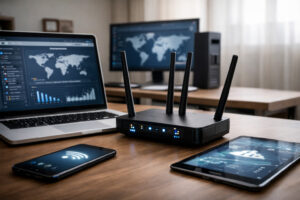

The devices that populate everyday life have undergone a transformation that extends beyond improvements in performance or design. What once functioned as isolated tools has gradually become part of a continuously active network, where interaction is no longer confined to a single device or moment. This shift reflects broader changes in how connectivity is embedded into modern systems, influencing how devices are built, used, and integrated.
Early consumer technologies were shaped by limitations in processing power, storage, and communication capabilities. As these constraints diminished, devices expanded in functionality while becoming more compact. Over time, the value of a device became less dependent on internal specifications and more defined by its ability to interact with external systems. This transition altered expectations, placing greater emphasis on synchronization, adaptability, and persistent access.
The result is an environment where consumer devices operate as interconnected components within a larger ecosystem, continuously exchanging data and responding to dynamic conditions.
Shifting From Isolated Tools to Networked Systems
Consumer devices were not originally designed to communicate with one another. Early personal computers, media players, and mobile phones functioned independently, each fulfilling a specific purpose within a limited context. Interaction between devices required deliberate effort, often involving physical connections or manual data transfer through removable storage.
As connectivity expanded, these boundaries began to dissolve. Wireless communication introduced the ability for devices to exchange data without direct physical links. This development reduced friction in interaction and enabled synchronization across multiple environments. Files, settings, and services could move between devices without requiring continuous user intervention.
This shift redefined the role of individual devices. Rather than acting as complete and independent systems, they became access points within broader networks. Their functionality extended beyond local capabilities to include services hosted elsewhere, often in real time. As a result, expectations evolved toward seamless transitions between devices and continuous availability of data.
The movement toward networked systems also influenced design priorities. Reliability of communication, compatibility across platforms, and responsiveness to changing conditions became central considerations. Devices were no longer evaluated solely by their standalone performance, but by how effectively they participated within interconnected environments.
Hardware Miniaturization and Performance Expansion
Advancements in semiconductor technology enabled significant changes in the physical structure of consumer devices. Components became smaller, more efficient, and capable of handling increasingly complex operations. This miniaturization allowed devices to become more portable while maintaining, and often exceeding, previous levels of performance.
Processing power and storage capacity increased steadily, enabling devices to handle multiple applications simultaneously. Tasks that once required dedicated systems could now be performed within compact, multifunctional devices. This expansion of capability supported new forms of interaction, productivity, and content consumption.
Energy efficiency became an equally important factor. As devices became more portable, expectations for extended usage without frequent charging grew. Improvements in battery technology and power management systems allowed devices to maintain connectivity while minimizing energy consumption. This balance between performance and efficiency became a defining characteristic of modern device design.
Miniaturization also influenced physical design. Devices became more integrated, with fewer visible components and more streamlined structures. This integration contributed to durability and portability, while also reinforcing the perception of devices as unified systems rather than assemblies of separate parts.
Software Ecosystems and Platform Integration
The expansion of hardware capabilities required corresponding evolution in software. Operating systems became more sophisticated, managing complex interactions between hardware resources and applications. At the same time, software platforms emerged as central elements that enabled connectivity and coordination across devices.
Software ecosystems introduced a framework where applications could be developed independently and distributed across devices. This approach allowed for a wide range of services to be accessed through a single platform, supporting flexibility and innovation. Developers could create applications that functioned across multiple devices while maintaining compatibility within the ecosystem.
Integration across devices became increasingly seamless. Data synchronization allowed users to move between devices without losing context, whether accessing documents, media, or communication tools. This continuity depended on software platforms that coordinated interactions and maintained consistency across environments.
The relationship between hardware and software evolved into a tightly coupled system. Hardware capabilities influenced software design, while software requirements drove the development of new hardware features. This ongoing interaction accelerated the pace of technological change and shaped the direction of consumer device development.
Analytical Core: Convergence of Devices and Continuous Connectivity
The convergence of devices within connected environments represents one of the most significant shifts in consumer technology. Devices no longer operate as isolated units but as participants in systems that rely on continuous communication and coordination.
Connectivity has become a foundational requirement. Devices maintain persistent links to networks, enabling real-time updates and interactions. This persistence supports applications that depend on immediate responsiveness, including communication services, media delivery, and automation systems.
Functionality is increasingly distributed. Tasks are not confined to the device itself but are shared across networks, allowing processing and storage to occur in multiple locations. This distribution expands capabilities while reducing dependence on local resources.
Interoperability is essential in this context. Devices from different manufacturers must operate within shared environments, requiring standardized communication protocols and data formats. Achieving consistent interaction across diverse systems remains a complex challenge, but it is central to maintaining cohesive ecosystems.
The convergence of devices also introduces new forms of dependency. Systems become interconnected in ways that require coordination to maintain stability. A change or disruption in one component can influence others, highlighting the need for robust system design.
Data exchange is central to this environment. Devices continuously generate and process information, often in real time. Managing this flow requires systems capable of adapting to variations in network conditions and user demand.
Security considerations are integrated into this convergence. As connectivity increases, so does the importance of protecting data and maintaining system integrity. Security becomes a shared responsibility across devices, platforms, and networks.
Emergence of Mobile-Centric Interaction Models
Mobile devices introduced a new model of interaction, emphasizing portability and constant access. Unlike earlier technologies that were tied to fixed locations, mobile devices allowed users to engage with digital systems in a wide range of contexts.
This shift influenced how devices were designed and used. Interfaces became more intuitive, relying on touch-based interaction and simplified navigation. Applications were optimized for smaller screens, focusing on efficiency and clarity.
Connectivity played a central role in mobile adoption. Continuous access to networks allowed users to remain connected regardless of location. This capability redefined expectations, making persistent connectivity a standard feature rather than a specialized function.
Mobile-centric design principles extended beyond smartphones. Other devices began to incorporate similar features, including wireless connectivity, compact form factors, and user-friendly interfaces. This influence contributed to a broader transformation in how consumer devices were developed.
Smart Devices and Embedded Intelligence
The integration of sensors and processing capabilities into everyday objects led to the emergence of smart devices. These devices can collect data, interpret it, and respond to changes without requiring direct input.
Embedded intelligence allows devices to adapt to patterns of use and environmental conditions. Systems can adjust behavior based on data inputs, creating responsive environments that operate with minimal manual intervention.
Connectivity enables these devices to function as part of larger systems. Data generated by one device can influence others, creating coordinated responses across networks. This interconnectedness extends functionality beyond individual devices.
The development of smart devices reflects a broader trend toward automation. Devices are designed not only to execute commands but to respond dynamically to changing conditions.
Cloud Integration and Distributed Functionality
Cloud computing has become a central component of modern device ecosystems. By providing access to remote storage and processing resources, cloud systems extend the capabilities of devices beyond their physical limitations.
Data can be accessed from multiple devices, supporting continuity and flexibility. Applications leverage cloud infrastructure to perform complex operations without relying solely on local processing power.
Cloud integration supports scalability. Services can adapt to changing demand, ensuring efficient use of resources. This flexibility is particularly important in environments with variable usage patterns.
The relationship between devices and cloud systems is dynamic. Devices act as interfaces to distributed resources, while cloud platforms provide the infrastructure that enables these interactions.
User Experience and Interface Evolution
As device capabilities expanded, the importance of user experience increased. Interfaces evolved to simplify interaction, making complex systems accessible without requiring technical expertise.
Modern interfaces incorporate gestures, voice input, and contextual awareness. These features align interaction with natural behavior, reducing friction and improving usability.
Consistency across devices is essential. Users expect similar interactions regardless of the device they use. Achieving this consistency requires coordination between hardware design and software development.
Interface evolution reflects a shift toward seamless integration. Devices are expected to support tasks without emphasizing the complexity of underlying systems.
Energy Efficiency and Sustainability Pressures
The growth in device usage has increased demand for energy, leading to greater focus on efficiency. Manufacturers aim to reduce power consumption while maintaining performance.
Advances in battery technology and power management systems have extended device operation times. At the same time, sustainability considerations influence material selection and production processes.
Energy consumption extends beyond individual devices. Data centers and network infrastructure contribute significantly to overall demand. Addressing these challenges requires coordinated efforts across the entire ecosystem.
Sustainability has become a key factor in evaluating technology, shaping how devices are designed and deployed.
Conclusion
Consumer devices have undergone a gradual but significant transformation, evolving from isolated tools into interconnected components within dynamic systems. This change reflects advances in connectivity, processing capability, and system integration.
Devices now function as access points to distributed environments, combining local performance with external resources. Their role continues to expand as systems become more integrated and responsive to changing conditions.
The ongoing evolution of consumer technology is shaped by technological innovation, user expectations, and broader systemic influences. Rather than reaching a fixed endpoint, devices continue to adapt within interconnected systems shaped by continuous connectivity and structured interaction.