
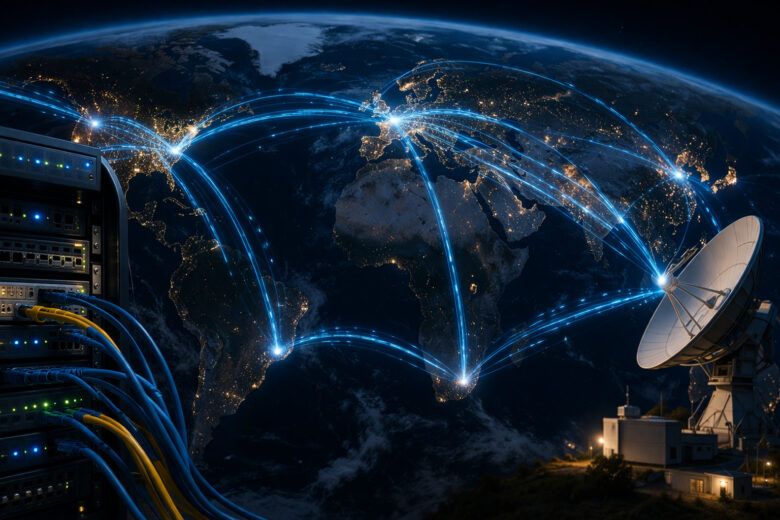
The first time I spent several hours inside a carrier-neutral data facility, what stood out was not the scale of the servers. It was the noise. Cooling systems, transfer clicks, fan walls, overhead cable trays, monitoring screens showing routing alerts every few seconds. The internet is often described as something abstract or remote, but the operational side feels surprisingly mechanical once you stand close to the infrastructure itself.
A large percentage of global digital traffic still depends on physical systems concentrated in relatively small geographic corridors. Fiber routes, submarine cable landings, regional exchange facilities, and hyperscale data centers form the basic structure that allows applications, streaming services, banking systems, enterprise platforms, and cloud-hosted tools to operate continuously across continents.
According to public infrastructure reports from organizations such as TeleGeography and the International Telecommunication Union, international bandwidth capacity has expanded significantly over the last decade, largely due to continued growth in cloud computing, streaming traffic, AI-related workloads, and enterprise synchronization systems. However, despite the scale of digital networks, many operational limitations remain tied to geography, routing connections, power availability, and physical infrastructure density.
Capacity itself also does not describe the complete condition of a network. Installed bandwidth, presently available bandwidth, actual traffic utilization, and redundant capacity are different things. A route can have significant theoretical capacity while operational options become smaller after one fiber path or interconnection point becomes unavailable.
The Web Still Depends on Physical Routes
Most users experience digital services through interfaces rather than infrastructure. A message loads. A video starts. A cloud file syncs automatically. Behind those actions, however, data usually passes through multiple interconnected systems before reaching its destination.
Submarine fiber-optic cables continue to carry the majority of global internet traffic. Public infrastructure mapping projects show hundreds of active undersea cable systems connecting major regional hubs across North America, Europe, Asia, the Middle East, Africa, and South America. These cables arrive at coastal stations before connecting into terrestrial backbone networks operated by telecommunications providers and infrastructure companies.
The physical cable is only one portion of this path. Landing facilities, terrestrial backhaul, optical transport equipment, carrier networks, exchange points, and eventually the infrastructure hosting the requested service all become parts of the wider route.
This distinction becomes useful during a disruption because a cable landing can remain operational while another terrestrial segment farther inland creates the actual limitation. From the user side both situations can simply appear as slower or unavailable service.
I noticed during one infrastructure audit project several years ago that network charts used internally were often far more complex than the simplified architecture diagrams shown publicly. Even relatively direct traffic paths could include regional transit agreements, redundant failover systems, distributed caching layers, and multiple routing policy decisions happening simultaneously.
Distance still affects performance. Data traveling between Frankfurt, Singapore, and Northern Virginia may cross several independent carrier environments before reaching a cloud-hosted application endpoint. Under normal conditions, those transfers happen within fractions of a second. During congestion events or routing instability, latency increases can become noticeable surprisingly quickly.
Propagation distance places one limitation that software optimization cannot completely remove. Routing policy can add another one because the path selected between two networks does not continuously need to be the geographically shortest possible path.
For operational analysis this makes round-trip latency more useful when examined beside route changes and packet loss. A latency increase by itself shows that timing changed, but it does not automatically explain whether distance, congestion, routing, or another condition produced it.
Routing Choices Are Continually Changing
Global network traffic does not move through fixed paths permanently assigned between two locations. Routing systems adjust continuously based on network availability, congestion, peering relationships, maintenance activity, and operational policy changes.
Border Gateway Protocol (BGP) remains one of the core components used to exchange routing information between independent systems across the internet. Large telecommunications operators, cloud providers, enterprise carriers, and content delivery platforms all participate in this broader routing environment.
BGP operates around reachability information and policy between autonomous systems. This is different from imagining one central internet controller calculating a universal fastest route for every connection.
An organization can announce which network prefixes it can reach, while neighboring networks make their own decisions about accepting and propagating that information. The resulting internet path therefore develops from decisions made across several independently operated networks.
In my experience reviewing operational dashboards inside enterprise networking environments, routing changes rarely appear dramatic at first glance. A path adjustment may increase latency by only a few milliseconds. However, across financial systems, cloud collaboration platforms, streaming services, or industrial monitoring systems, small timing variations can influence application responsiveness in noticeable ways.
Route convergence matters after availability changes. When one path disappears, routing information needs time to propagate and alternative reachability needs to become usable. The service can therefore experience a short unstable period even where redundant infrastructure exists.
Public outage reports from recent years have shown how localized failures sometimes create wider structural effects. A cable disruption, routing leak, or exchange point instability in one region may trigger traffic redistribution elsewhere, especially during periods of high utilization. Network operators often design redundancy into backbone systems, but failover behavior still depends heavily on available capacity and regional interconnection density.
Redundancy on a diagram does not continuously mean complete physical independence. Two logical connections can eventually share conduit, building infrastructure, power, or another common physical dependency. A single event affecting that shared portion can remove paths that appeared separate at another layer.
Some regions maintain extensive exchange environments with dozens of interconnected providers. Others depend on fewer upstream connections, which can make rerouting options more limited during disruptions.
Regional Infrastructure Shapes User Experience
Global connectivity is uneven. Large metropolitan centers with dense infrastructure footprints usually experience lower latency, broader provider competition, and greater routing diversity than regions dependent on limited backbone access.
Cloud providers have increasingly expanded regional deployment strategies to reduce these differences. Major infrastructure companies now operate distributed availability zones, edge computing environments, and regional caching systems closer to high-demand population centers.
Bringing content or processing closer toward users can reduce the amount of long-distance transport required for repeated requests. It does not eliminate backbone networks, but it can change which traffic needs to cross them and how frequently.
Streaming traffic provides a useful example. Several network engineers I spoke with during earlier editorial research projects described how content delivery systems significantly changed bandwidth patterns over the last decade. Instead of repeatedly moving large media files across long-distance international routes, providers now duplicate popular content across localized caching infrastructure.
Before widespread CDN deployment became standard practice, long-distance transit usage was often far less predictable during major media events. Current systems distribute demand more efficiently, although large spikes still happen during globally synchronized broadcasts or software deployment cycles.
Cache efficiency changes the picture again. Content already available close toward the user can follow a different delivery path from less frequently requested content that still needs to be retrieved from a more distant origin or another cache layer.
Industry estimates suggest streaming-related traffic can represent more than half of peak evening consumer bandwidth usage in some markets. Exact percentages vary by region and measurement method, but the broader operational trend remains visible across public infrastructure reporting.
Inside Large-Scale Data Center Operations
Public discussions around cloud computing often emphasize software, automation, or artificial intelligence. Inside data centers themselves, the operational reality is much more physical.
Rows of networking equipment, organized cabling systems, redundant power supplies, battery backup installations, and cooling infrastructure operate continuously under carefully monitored environmental conditions. In one facility walkthrough I attended during a regional infrastructure review, temperature variation across specific hardware aisles was being monitored down to fractions of a degree because sustained thermal imbalance could affect equipment lifespan and failure rates over time.
Power and cooling are connected with computing density. Increasing the amount of equipment that can operate inside one facility also increases the need to deliver electrical power and remove generated heat without producing unstable environmental conditions.
Redundancy can exist at several levels: utility feeds, backup power, power distribution, network links, cooling components, and computing equipment. These layers have different failure behavior, so the presence of redundancy in one area does not automatically protect another area.
Hyperscale operators now build facilities measured in hundreds of megawatts of projected power usage. According to publicly available development disclosures and infrastructure reports, some newer campuses support multiple independent substations, redundant fiber paths, and layered failover designs created for continuous uptime requirements.
Even with that level of redundancy, failures still occur.
Maintenance mistakes, firmware incompatibilities, power distribution issues, optical equipment degradation, and routing misconfigurations remain recurring operational risks. The difference today is that large infrastructure providers often isolate failures faster than they could a decade ago due to improved telemetry visibility and automated monitoring systems.
Maintenance itself can create a risk window. A normally redundant system may temporarily operate with fewer available components while equipment is being replaced, upgraded, or tested. Another failure during this period can therefore have a different effect from the same failure under normal configuration.
That does not completely remove downstream effects. Shared dependencies across interconnected platforms can sometimes amplify relatively contained technical problems.
A useful incident review consequently looks beyond the first component that failed. It also asks which services depended on it, which redundancy was expected to operate, whether failover occurred, and where remaining capacity became constrained afterward.
Traffic Growth Is Changing Infrastructure Planning
AI-related compute demand, cloud migration, remote collaboration systems, and connected industrial environments have all contributed to continued bandwidth growth globally.
Several infrastructure analysts have pointed out that modern network planning increasingly focuses not only on peak throughput, but also on traffic consistency. Enterprise synchronization workloads, large-scale data replication, machine learning pipelines, and distributed application designs create continuous infrastructure demand that differs from older consumer-focused traffic models.
Peak traffic and sustained traffic create different planning conditions. A network can absorb a short burst by using temporary available capacity, while continuously elevated utilization reduces how much spare capacity remains for unexpected events or failover.
I have seen monitoring environments where overnight usage remained unexpectedly high because enterprise backup systems, cloud replication jobs, and automated software deployments were running at the same time across multiple regions. Ten years ago, many backbone systems experienced more noticeable quiet periods outside business hours. In many environments, those differences have narrowed considerably.
This shift has operational consequences beyond bandwidth itself. Power usage, cooling requirements, equipment refresh cycles, and fiber expansion planning all become more demanding when sustained utilization levels rise for extended periods.
Equipment expansion also takes different amounts of time depending on what is constrained. Adding logical capacity can be relatively fast in some environments, while new fiber construction, power infrastructure, substations, buildings, or cable systems can require much longer planning periods.
Public infrastructure filings from major telecommunications and cloud providers increasingly reference long-term expansion planning connected to AI infrastructure, regional data requirements, and enterprise cloud adoption trends.
Network Strength Depends on Coordination
One of the more overlooked aspects of global internet infrastructure is how dependent it remains on cooperation between independent organizations.
Traffic exchange agreements, peering relationships, standards coordination, hardware compatibility, and regional operational planning all influence stability. No single operator controls the internet as one unified system. Instead, thousands of independent networks coordinate routing behavior through shared technical standards and commercial relationships.
This creates an operational boundary during incidents. One provider can understand its own equipment and routing state very well while having more limited visibility into what is happening inside another independently managed network farther along the path.
Troubleshooting between organizations therefore often depends on comparing timestamps, route information, traffic behavior, interface statistics, and other evidence until the affected boundary becomes clearer.
That decentralized structure creates both resilience and complexity.
A routing issue introduced by one provider may spread unexpectedly if filtering policies elsewhere fail to contain it. At the same time, decentralized infrastructure often prevents localized failures from becoming widespread outages.
Routing security practices can reduce some of these risks by validating which networks are expected to originate particular route information. They do not remove every operational mistake, but they provide another control against incorrect routing announcements being accepted too broadly.
A balanced perspective matters here because infrastructure quality varies significantly between regions. Some markets benefit from dense carrier competition and mature exchange environments. Others still face capacity limitations, regulatory challenges, or insufficient redundancy investment.
The gap between highly connected metropolitan hubs and less-developed regional infrastructure remains noticeable in latency measurements, service stability, and international bandwidth pricing.
Observability Has Become Central to Modern Networks
Modern infrastructure operations depend heavily on observability systems. Metrics collection, telemetry analysis, anomaly detection, and automated alerting tools now form a significant part of daily network management.
During a workflow review involving enterprise monitoring systems, I noticed operators rarely focused on single measurements in isolation. Packet loss, throughput variation, route convergence timing, hardware utilization, and environmental conditions were evaluated together because isolated measurements often failed to explain broader system behavior accurately.
That relationship between signals matters. High latency with no packet loss can describe a different condition from rising latency accompanied by interface errors and packet loss. High hardware utilization can mean something else again when traffic volume itself has not increased.
Baselines also give context. A utilization value that looks high in isolation can be ordinary for one link at that hour, while a smaller value on another link can represent a major change from its normal operating pattern.
This operational visibility becomes especially important during cascading failures or unpredictable traffic events.
Large providers now process massive volumes of telemetry data continuously to identify developing instability before users notice service degradation. According to many industry infrastructure presentations published in recent years, predictive maintenance and automated traffic engineering have become increasingly important as network scale expands.
Alert quality becomes part of this process. If thresholds are too sensitive, operators can receive enough low-value alerts that important events become harder to separate. If they are too loose, degradation can continue longer before the monitoring system raises attention.
Correlating several signals can reduce this problem. A route change, packet-loss increase, optical power warning, and traffic shift appearing around the same time provides more operational context than four unrelated alerts examined independently.
Still, observability has limits. Some failures develop too quickly for automated systems to compensate immediately. Others originate from external conditions outside direct provider control.
Monitoring also sees only what has been instrumented. Missing telemetry from a device, external carrier, power component, or another dependency can leave a blind area precisely when an incident crosses organizational or technical boundaries.
Global connectivity feels seamless most of the time because thousands of operational decisions remain invisible beneath the surface. Once traffic volumes reach international scale, even minor configuration changes can influence millions of simultaneous connections.
Technical Review and Sources
This infrastructure overview is considered through physical routes, submarine cable systems, BGP routing, regional interconnection, CDN distribution, data center operation, capacity planning, provider coordination, and observability. These layers are separated because one visible user slowdown can develop from very different physical or logical portions of the wider network.
The first-hand observations already described in this article provide operational context around facility conditions, routing dashboards, infrastructure review, network-engineer discussions, and monitoring workflows. They should remain limited to the experiences actually described here rather than being expanded into claims about facilities or systems that were not personally observed.
Public quantitative statements concerning international bandwidth, submarine cables, regional connectivity, and global telecommunications conditions ought to remain connected to current infrastructure reporting because capacity and deployment figures change over time.
Last technical review: September 2026
References
TeleGeography. Submarine cable maps, global bandwidth research, and telecommunications infrastructure reporting.
International Telecommunication Union. Global connectivity and telecommunications infrastructure statistics.
Internet Engineering Task Force. Border Gateway Protocol and internet routing standards.
Internet Society. Internet routing, interconnection, and infrastructure resources.
Regional Internet Registries. Autonomous system, routing, and internet number resource information.