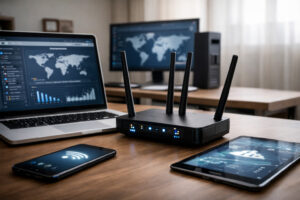

The gadgets that populate ordinary life have experienced a change that expands past advancements in execution or plan. What once worked as disconnected devices has slowly ended up portion of a persistently dynamic arrange, where interaction is no longer limited to a single gadget or minute. This move reflects broader changes in how network is implanted into advanced frameworks, impacting how gadgets are built, utilized, and integrated.
Early shopper advances were molded by restrictions in handling control, capacity, and communication capabilities. As these limitations reduced, gadgets extended in usefulness whereas getting to be more compact. Over time, the esteem of a gadget got to be less subordinate on inside details and more characterized by its capacity to connected with outside frameworks. This move modified desires, setting more prominent accentuation on synchronization, versatility, and diligent access.
The result is an environment where customer gadgets work as interconnected components inside a bigger biological system, ceaselessly trading information and reacting to energetic conditions.
This connection also changes what gadget failure can mean. A device can remain physically operational while one remote service, account connection, synchronization pathway, or network dependency becomes unavailable. The hardware did not necessarily fail, but portion of the expected experience can still disappear.
Looking at the device together with these dependencies gives a more complete picture than examining processor, memory, or battery specifications alone.
Shifting From Separated Apparatuses to Organized Systems
Consumer gadgets were not initially outlined to communicate with one another. Early individual computers, media players, and versatile phones worked autonomously, each satisfying a particular reason inside a constrained setting. Interaction between gadgets required consider exertion, frequently including physical associations or manual information exchange through detachable storage.
As network extended, these boundaries started to break down. Remote communication presented the capacity for gadgets to trade information without coordinate physical joins. This improvement diminished grinding in interaction and empowered synchronization over different situations. Records, settings, and administrations may move between gadgets without requiring nonstop client intervention.
Synchronization introduces questions that did not exist in the same way for isolated devices. Two gadgets can modify the same information before either receives the other change. The surrounding system then needs to decide which state should remain or how both changes should be combined.
Network interruption creates another case. A gadget may continue operating locally while updates remain waiting for a connection. When connectivity returns, delayed information needs to enter the wider environment without silently replacing newer state created elsewhere.
This move re-imagined the part of person gadgets. Or maybe than acting as total and free frameworks, they got to be get to focuses inside broader systems. Their usefulness expanded past neighborhood capabilities to incorporate administrations facilitated somewhere else, frequently in genuine time. As a result, desires advanced toward consistent moves between gadgets and persistent accessibility of data.
The development toward organized frameworks too impacted plan needs. Unwavering quality of communication, compatibility over stages, and responsiveness to changing conditions got to be central contemplations. Gadgets were no longer assessed exclusively by their standalone execution, but by how successfully they taken part inside interconnected environments.
Hardware Miniaturization and Execution Expansion
Advancements in semiconductor innovation empowered noteworthy changes in the physical structure of shopper gadgets. Components got to be littler, more proficient, and able of dealing with progressively complex operations. This miniaturization permitted gadgets to gotten to be more convenient whereas keeping up, and frequently surpassing, past levels of performance.
Processing control and capacity capacity expanded relentlessly, empowering gadgets to handle numerous applications at the same time. Assignments that once required committed frameworks may presently be performed inside compact, multifunctional gadgets. This extension of capability backed modern shapes of interaction, efficiency, and substance consumption.
Peak performance and sustained performance do not continuously describe the same condition in a compact gadget. Higher processing activity creates heat and consumes energy. A device can consequently reduce performance after longer intensive operation to remain inside thermal or power limitations.
This means hardware capability needs to be understood together with cooling, battery condition, workload duration, and power management.
Energy productivity got to be an similarly imperative calculate. As gadgets got to be more versatile, desires for amplified utilization without visit charging developed. Advancements in battery innovation and control administration frameworks permitted gadgets to keep up network whereas minimizing vitality utilization. This adjust between execution and effectiveness got to be a characterizing characteristic of present day gadget design.
Background connectivity creates part of this balance. A device that keeps every radio, sensor, and application fully active can provide fast reaction but consume more energy.
Sleep states, scheduled background work, adaptive refresh, and selective radio activity allow the system to reduce energy use while trying to preserve the appearance of continuous availability.
Miniaturization too affected physical plan. Gadgets got to be more coordinates, with less obvious components and more streamlined structures. This integration contributed to toughness and transportability, whereas too strengthening the recognition of gadgets as bound together frameworks or maybe than gatherings of isolated parts.
Higher integration can make repair and component replacement more complicated in some designs. Physical compactness therefore creates trade-offs beside its benefits in portability and space efficiency.
Software Environments and Stage Integration
The extension of equipment capabilities required comparing advancement in program. Working frameworks got to be more advanced, overseeing complex intelligent between equipment assets and applications. At the same time, computer program stages risen as central components that empowered network and coordination over devices.
Software environments presented a system where applications may be created freely and conveyed over gadgets. This approach permitted for a wide run of administrations to be gotten to through a single stage, supporting adaptability and development. Engineers may make applications that worked over numerous gadgets whereas keeping up compatibility inside the ecosystem.
Compatibility can change as software develops. An operating-system update can introduce new capabilities while an older application still depends on behavior from a previous version.
Testing across supported versions becomes important because successful installation does not continuously guarantee every feature will operate identically.
Integration over gadgets got to be progressively consistent. Information synchronization permitted clients to move between gadgets without losing setting, whether getting to records, media, or communication apparatuses. This coherence depended on program stages that facilitated intuitive and kept up consistency over environments.
Account identity becomes one of the mechanisms connecting this experience. The platform needs to determine which devices belong toward the same user context and which information each device is authorized to receive.
Device replacement adds another lifecycle event. Credentials, synchronized state, backups, and permissions may need movement toward the new device while access from the retired one should no longer remain unnecessarily active.
The relationship between equipment and program advanced into a firmly coupled framework. Equipment capabilities affected program plan, whereas computer program necessities drove the advancement of modern equipment highlights. This continuous interaction quickened the pace of innovative alter and molded the heading of shopper gadget development.
Meeting of Gadgets and Ceaseless Connectivity
The joining of gadgets inside associated situations speaks to one of the most critical shifts in shopper innovation. Gadgets no longer work as separated units but as members in frameworks that depend on ceaseless communication and coordination.
Connectivity has ended up a foundational prerequisite. Gadgets keep up determined joins to systems, empowering real-time upgrades and intelligent. This determination bolsters applications that depend on prompt responsiveness, counting communication administrations, media conveyance, and robotization systems.
Persistent connectivity does not mean a perfectly uninterrupted connection. Wireless signal can weaken, devices can move between networks, routers can restart, and remote services can become temporarily unavailable.
Applications that expect ordinary connectivity interruptions can preserve local state, retry selected operations, or show clearly that information has not synchronized yet.
Functionality is progressively conveyed. Errands are not limited to the gadget itself but are shared over systems, permitting handling and capacity to happen in different areas. This conveyance grows capabilities whereas lessening reliance on neighborhood resources.
Local and remote processing create different strengths. Local processing can continue without a network and can reduce the need to transmit some information. Remote processing can provide resources beyond what a compact device can practically contain.
Many connected environments consequently use both instead of depending completely on one side.
Interoperability is fundamental in this setting. Gadgets from diverse producers must work inside shared situations, requiring standardized communication conventions and information designs. Accomplishing steady interaction over differing frameworks remains a complex challenge, but it is central to keeping up cohesive ecosystems.
Protocol support alone does not continuously produce full interoperability. Two products can exchange information successfully while still using different meanings for device state, capabilities, or control behavior.
Shared data models and consistent interpretation become important beside basic network compatibility.
The merging of gadgets too presents unused shapes of reliance. Frameworks ended up interconnected in ways that require coordination to keep up soundness. A alter or disturbance in one component can impact others, highlighting the require for vigorous framework design.
Data trade is central to this environment. Gadgets ceaselessly create and handle data, regularly in genuine time. Overseeing this stream requires frameworks competent of adjusting to varieties in organize conditions and client demand.
Data freshness needs attention here. Information can be transmitted successfully but arrive after enough delay that it no longer represents the present condition.
Source timestamps and synchronization state can help separate fresh device information from older data that arrived after temporary disconnection.
Security contemplations are coordinates into this joining. As network increments, so does the significance of securing information and keeping up framework astuteness. Security gets to be a shared duty over gadgets, stages, and networks.
Device authentication, encrypted communication, supported software updates, and removal of old access credentials become practical portions of this responsibility.
Emergence of Mobile-Centric Interaction Models
Mobile gadgets presented a modern show of interaction, emphasizing compactness and consistent get to. Not at all like prior advances that were tied to settled areas, portable gadgets permitted clients to lock in with computerized frameworks in a wide extend of contexts.
This move affected how gadgets were planned and utilized. Interfacing got to be more instinctive, depending on touch-based interaction and rearranged route. Applications were optimized for littler screens, centering on proficiency and clarity.
Mobile operation also introduced changing physical conditions. Network quality, battery level, screen orientation, available sensors, background restrictions, and user movement can all change during one session.
Software consequently cannot always assume the stable connectivity and continuous power environment associated with a fixed computer.
Connectivity played a central part in versatile appropriation. Persistent get to to systems permitted clients to stay associated in any case of area. This capability re-imagined desires, making tireless network a standard include or maybe than a specialized function.
Moving between Wi-Fi and cellular connectivity gives one ordinary transition. An active application can experience a brief network change even though the user sees the device as continuously connected.
Applications handling longer sessions or transfers need to tolerate these changes without assuming one network path remains fixed.
Mobile-centric plan standards expanded past smartphones. Other gadgets started to consolidate comparable highlights, counting remote network, compact frame components, and user-friendly interfacing. This impact contributed to a broader change in how customer gadgets were developed.
Smart Gadgets and Inserted Intelligence
The integration of sensors and preparing capabilities into ordinary objects driven to the development of keen gadgets. These gadgets can collect information, translate it, and react to changes without requiring coordinate input.
Embedded insights permits gadgets to adjust to designs of utilize and natural conditions. Frameworks can alter behavior based on information inputs, making responsive situations that work with negligible manual intervention.
Sensor output should not automatically be treated as perfect representation of the environment. Placement, calibration, contamination, physical wear, or changing surrounding conditions can influence measurements.
A technically connected sensor can therefore continue sending data while the data itself becomes less reliable.
Connectivity empowers these gadgets to work as portion of bigger frameworks. Information produced by one gadget can impact others, making facilitated reactions over systems. This interconnecting amplifies usefulness past person devices.
Automation can create feedback between components. One sensor measurement can trigger an actuator, the actuator changes the environment, and the new condition produces another sensor measurement.
Thresholds, timing limits, and state awareness can stop this loop from repeatedly switching between two conditions.
The improvement of savvy gadgets reflects a broader slant toward robotization. Gadgets are outlined not as it were to execute commands but to react powerfully to changing conditions.
Local manual control remains useful in many environments because automation or remote connectivity can fail independently from the physical device itself.
Cloud Integration and Dispersed Functionality
Cloud computing has gotten to be a central component of cutting edge gadget biological systems. By giving get to to farther capacity and preparing assets, cloud frameworks expand the capabilities of gadgets past their physical limitations.
Data can be gotten to from different gadgets, supporting coherence and adaptability. Applications use cloud foundation to perform complex operations without depending exclusively on neighborhood handling power.
This structure introduces latency and availability dependency. A feature relying completely on a remote service can behave differently during poor connectivity from one implemented locally.
Caching and local state can preserve selected functionality where the remote component is temporarily unreachable.
Cloud integration underpins adaptability. Administrations can adjust to changing request, guaranteeing productive utilize of assets. This adaptability is especially critical in situations with variable utilization patterns.
Large groups of devices can create synchronized demand. A software release, morning routine, service recovery, or reconnect event can cause many endpoints to contact cloud infrastructure around the same period.
Normal average traffic can consequently be much lower than temporary peak demand.
The relationship between gadgets and cloud frameworks is energetic. Gadgets act as interfacing to disseminated assets, whereas cloud stages give the foundation that empowers these interactions.
Cloud dependency also makes service lifecycle relevant toward hardware lifetime. A physical device may remain functional after a remote service changes or ends, but features dependent on that service can become reduced.
User Involvement and Interface Evolution
As gadget capabilities extended, the significance of client involvement expanded. Interfacing advanced to disentangle interaction, making complex frameworks open without requiring specialized expertise.
Modern interfacing join signals, voice input, and relevant mindfulness. These highlights adjust interaction with normal behavior, lessening grinding and moving forward usability.
Simplification can hide substantial system activity. One visible control can involve local processing, authentication, cloud requests, another device, and several network exchanges before the result appears.
When one hidden stage fails, useful interface feedback helps distinguish waiting, failure, and successful completion instead of presenting the same visual state for all three.
Consistency over gadgets is fundamental. Clients anticipate comparable intuitive notwithstanding of the gadget they utilize. Accomplishing this consistency requires coordination between equipment plan and computer program development.
Consistency does not require identical interface on every form factor. A watch, phone, television, and desktop can expose the same underlying service while requiring different interaction patterns because screen size and input method differ.
Interface advancement reflects a move toward consistent integration. Gadgets are anticipated to back errands without emphasizing the complexity of basic systems.
Energy Proficiency and Maintainability Pressures
The development in gadget utilization has expanded request for vitality, driving to more prominent center on productivity. Producers point to diminish control utilization whereas keeping up performance.
Advances in battery innovation and control administration frameworks have expanded gadget operation times. At the same time, supportability contemplations impact fabric choice and generation processes.
Battery behavior also changes through the product lifecycle. Available capacity can decline with age and use, changing the balance between performance, background activity, and expected operating time compared with a new device.
Software power management can respond toward these conditions by limiting selected background or high-demand operations.
Energy utilization expands past person gadgets. Information centers and arrange foundation contribute altogether to in general request. Tending to these challenges requires facilitated endeavors over the whole ecosystem.
A feature moved from local processing toward the cloud does not necessarily eliminate its energy requirement. Part of the work is moved toward network and data-center infrastructure instead.
For this reason, evaluating only the power consumed directly by the endpoint gives an incomplete picture of distributed functionality.
Sustainability has ended up a key calculate in assessing innovation, forming how gadgets are planned and deployed.
Product lifetime, software support, repair possibilities, battery replacement, material use, and eventual disposal can influence the wider sustainability profile beside electricity consumed during ordinary operation.
Conclusion
Consumer gadgets have experienced a continuous but noteworthy change, advancing from disconnected instruments into interconnected components inside energetic frameworks. This alter reflects progresses in network, preparing capability, and framework integration.
Devices presently work as get to focuses to disseminated situations, combining neighborhood execution with outside assets. Their part proceeds to grow as frameworks gotten to be more coordinates and responsive to changing conditions.
The continuous advancement of buyer innovation is molded by mechanical advancement, client desires, and broader systemic impacts. Or maybe than coming to a settled endpoint, gadgets proceed to adjust inside interconnected frameworks molded by nonstop network and organized interaction.
Technical Review and Sources
This consumer-device environment is considered through hardware capability, software integration, synchronization, connectivity, local and remote processing, embedded sensing, security, user interaction, energy behavior, and device lifecycle. Looking at these portions together is useful because one device can remain physically operational while part of its connected functionality is already unavailable.
Operational examples concerning offline synchronization, network transition, data freshness, cloud fallback, battery management, sensor reliability, device authentication, software updates, and remote-service dependency are technical scenarios rather than personal experience claims.
Exact behavior depends on device category, operating system, communication technology, hardware design, cloud architecture, battery condition, software version, and manufacturer support. Characteristics from one consumer-device ecosystem should therefore not automatically be transferred toward another.
Last technical review: September 2026
References
National Institute of Standards and Technology. Connected-device and Internet of Things cybersecurity resources.
Internet Engineering Task Force. Internet communication, networking, transport, and security standards.
Connectivity Standards Alliance. Connected-device interoperability and smart-device standards.
Bluetooth SIG. Bluetooth technology and interoperability documentation.
IEEE. Wireless communication, electronics, and computing standards resources.
FAQs
1. How did consumer devices move from standalone tools toward connected systems?
Consumer gadgets gradually gained wireless communication, software platforms, synchronization, and access toward remote services. This allowed information and functionality to move between several devices instead of remaining completely inside one physical product.
2. Why does cloud integration matter for modern consumer devices?
Cloud infrastructure allows devices to use remote storage and processing resources beyond their local hardware. It can support synchronization and distributed functionality, although it also introduces network and remote-service dependencies.
3. Does continuous connectivity mean a device is always online without interruption?
Not necessarily. Wireless conditions, network transitions, router problems, and service interruptions can temporarily break connectivity. Connected systems can use local state, retries, buffering, or reduced functionality to handle these periods.
4. Why is interoperability more complicated than supporting the same communication protocol?
Devices can successfully exchange information while still interpreting states, units, capabilities, or commands differently. Interoperability therefore includes shared meaning and behavior beside basic technical communication.
5. How does energy efficiency extend beyond the device itself?
Connected features can depend on network infrastructure and remote data centers. Some processing moved away from the device still consumes energy elsewhere, making the wider ecosystem relevant when considering total resource use.