
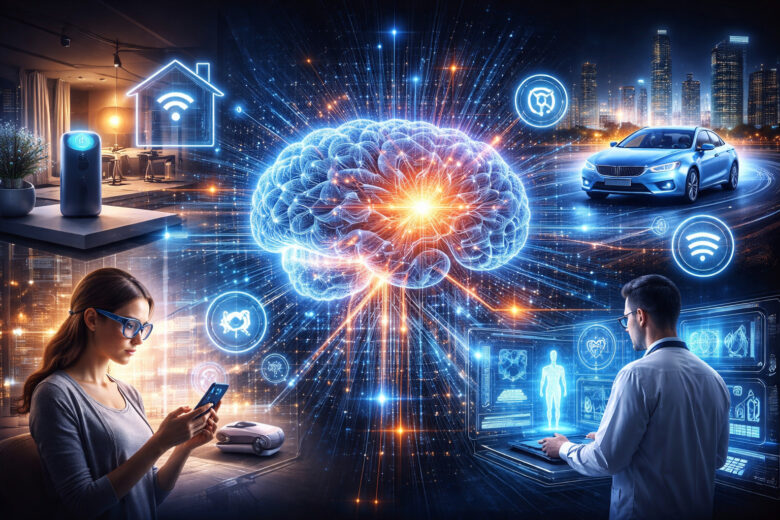
Every day schedules progressively unfurl inside frameworks that prepare data ceaselessly, translating signals from gadgets, applications, and systems that work in parallel. Manufactured insights has ended up inserted inside these frameworks, forming how errands are performed, how data is gotten to, and how situations react to human movement. Its impact is not constrained to specialized spaces; it amplifies into communication apparatuses, transportation frameworks, healthcare stages, and family innovations that work inside interconnected computerized structures.
This change reflects the integration of computational models into the foundation that bolsters ordinary interaction. Information created through schedule action is analyzed in genuine time, permitting frameworks to alter yields, suggest activities, or mechanize forms without coordinate instruction. Program stages facilitate these intelligent, whereas arrange network empowers nonstop trade between neighborhood gadgets and conveyed handling systems.
The discernible impact is a move in how innovation works inside conventional situations. Gadgets no longer work exclusively as detached devices but take part in forms that adjust powerfully, making conditions where usefulness advances nearby client behavior and changing inputs.
This adjustment does not continuously mean that an AI model is retraining itself during every interaction. Numerous frameworks keep a deployed model generally settled while surrounding information, rules, and application state continue changing. New versions can later pass through evaluation and controlled deployment.
It is moreover useful to separate model output from final system action. A model can produce a probability, classification, recommendation, or another signal, while software rules or a human decision determine what actually happens from that output.
Intelligent Frameworks in Shopper Devices
Consumer gadgets progressively join AI-driven usefulness that reshapes interaction. Smartphones, wearable gadgets, and domestic colleagues handle information related to client input, natural setting, and utilization designs. These frameworks decipher signals in genuine time, empowering gadgets to react with versatile behavior that alters based on context.
Embedded processors outlined for machine learning assignments bolster neighborhood examination, diminishing reliance on outside frameworks for prompt operations. Discourse acknowledgment, facial distinguishing proof, and relevant mindfulness can be dealt with straightforwardly on gadgets, permitting for quick reaction times. At the same time, more complex examination may happen through disseminated frameworks, with comes about transmitted back to the device.
On-device processing and remote processing bring different operational conditions. Local execution can reduce network delay and keep selected information from leaving the gadget, but it works inside tighter memory, energy, and thermal boundaries.
Remote processing can provide greater computational capacity, although a feature then becomes more dependent on connectivity and the availability of the remote service.
This double structure, combining neighborhood and farther computation, characterizes how buyer innovation works inside present day situations. Gadgets keep up responsiveness whereas getting to broader explanatory capabilities, reflecting a adjust between independence and connectivity.
A hybrid design can use both. Immediate or privacy-sensitive processing may happen locally, while larger analysis is moved toward remote infrastructure. The useful balance depends on workload size, response requirement, device capability, and information sensitivity.
Data Streams and Ceaseless Analysis
Artificial insights frameworks depend on nonstop information stream, where data is collected, transmitted, and handled over numerous layers of framework. Information begins from sensors, applications, and client intelligent, shaping streams that bolster into explanatory models.
Processing happens inside conveyed situations that translate designs and create yields. These yields impact proposals, trigger computerized forms, or alter framework behavior. As unused information is created, the cycle proceeds, shaping an progressing circle of investigation and response.
A stream being active does not continuously mean its information is current. Events can accumulate inside queues when processing becomes slower than incoming production. The framework remains online while analysis starts operating against progressively older conditions.
For real-time use, data age can therefore matter beside simple availability. Timestamps, queue age, and processing delay can help identify whether an output describes the current environment or one that already changed.
This approach varies from prior computational models that depended on discrete handling occasions. AI-driven frameworks work inside ceaseless streams, permitting them to stay adjusted with real-time conditions and adjust to changes as they occur.
Input validation becomes important before analysis. Missing fields, changed units, unusual sensor values, or an altered data schema can produce different model behavior even though information still moves successfully through the pipeline.
AI in Communication and Data Access
Communication stages progressively depend on fake insights to oversee and translate data. Informing frameworks channel substance, prioritize intuitive, and propose reactions based on relevant examination. Look motors prepare inquiries utilizing models that decipher expectation, making strides the significance of results.
Content conveyance frameworks analyze client behavior to decide how data is displayed. News bolsters, spilling administrations, and social stages alter yields based on interaction designs, forming how substance is gotten to and consumed.
Ranking should be separated from the underlying information itself. An AI system can influence which available items appear first without necessarily changing the original material.
This distinction matters when examining system behavior because availability, ranking, recommendation, and final user selection represent different stages of the interaction.
The integration of AI into communication frameworks impacts how data streams over computerized situations. Frameworks organize and prioritize information powerfully, influencing the structure and availability of communication.
User behavior can also create a feedback loop. Items presented more prominently can receive more interaction, and this interaction can later become another signal used by the system. Evaluation therefore needs consideration of how system output itself can influence future input.
Automation in Residential Environments
Household innovations progressively consolidate robotization driven by fake insights. Savvy domestic frameworks oversee lighting, temperature, and security through facilitated interaction between gadgets. Sensors distinguish natural conditions, whereas AI models decide fitting reactions based on watched patterns.
These frameworks work ceaselessly in the foundation, altering settings without requiring coordinate input. Climate control may adjust to inhabitance designs, whereas lighting frameworks react to time and movement. The result is an environment that alters powerfully to changing conditions.
Sensor information is not continuously an exact description of physical reality. Placement, calibration, obstruction, environmental conditions, or hardware degradation can influence what one sensor reports.
Automation therefore benefits from boundaries around unusual or conflicting measurements rather than assuming every technically valid sensor value is correct.
Integration over gadgets improves usefulness. Apparatuses, excitement frameworks, and security components communicate through shared stages, making facilitated reactions that amplify past person gadget operation.
Fallback behavior becomes important when one part of the connected environment is unavailable. A local switch, thermostat, or security component can still require useful operation during internet interruption or remote-service failure.
Automation is more resilient when the failure of an intelligent layer does not remove every basic manual function underneath it.
Healthcare Frameworks and Prescient Analysis
Artificial insights contributes to healthcare frameworks by supporting information investigation forms utilized in observing and diagnostics. Frameworks prepare data from therapeutic imaging, quiet records, and sensor-based inputs to distinguish designs inside datasets.
Predictive models analyze chronicled and current information to recognize patterns that may illuminate assessment. These frameworks work nearby built up strategies, contributing extra explanatory perspectives.
A prediction is not identical toward a clinical conclusion. Model performance depends on the population, input quality, evaluation conditions, and intended use for which the system was developed and assessed.
A model showing useful performance for one dataset or patient group should not automatically be assumed toward another population without relevant validation.
The integration of AI into healthcare reflects broader designs in data-driven frameworks, where expansive volumes of data are deciphered to bolster understanding of complex conditions.
Human oversight becomes particularly relevant where an output can influence consequential decisions. A reviewer needs enough context to question or reject a model result rather than simply seeing an automated recommendation without meaningful supporting information.
Confidence or uncertainty can also influence workflow. Selected outputs may be appropriate for additional review instead of automatic action where the system has insufficient information or falls outside its ordinary operating conditions.
Transportation and Independent Systems
Transportation frameworks consolidate counterfeit insights to bolster route, activity coordination, and vehicle operation. Independent frameworks depend on sensors and machine learning models to decipher environment and react to changing conditions.
Traffic administration stages analyze information from vehicles and foundation to alter stream and decrease clog. These frameworks react powerfully, adjusting to real-time conditions over networks.
Real-time transportation systems operate with strict timing. A technically accurate result arriving after the physical situation already changed can have less operational value than the same result delivered inside the required response window.
Sensor fusion can combine several observations rather than relying on one input alone. Different sensor types can provide complementary information, although disagreement between them requires rules for how uncertainty is handled.
The interaction between vehicles, foundation, and information frameworks outlines how AI contributes to facilitated versatility situations where numerous components work together.
Network connectivity can support broader coordination, but selected immediate functions may need local processing because remote communication cannot guarantee constant latency or availability.
Workplace Change and Handle Automation
Artificial insights has impacted working environment forms by presenting robotization and data-driven examination into operational workflows. Computer program stages coordinated models that prepare data, distinguish designs, and back decision-making.
Routine assignments such as planning, information handling, and detailing are progressively dealt with by computerized frameworks. This permits human members to center on exercises that require elucidation and oversight.
Automation can move work rather than simply remove it. Repetitive processing may decrease while review of exceptions, system configuration, validation, and investigation of unusual outputs become more important.
This creates a requirement for clear escalation. A workflow needs to identify what happens when the model has low confidence, required information is missing, or an automated action cannot complete.
Collaboration devices join AI highlights that organize data, oversee workflows, and give bits of knowledge into framework action. These capabilities back more proficient coordination inside organizational environments.
Audit information can support later review where automated output influenced an important process. Model version, relevant input, generated output, and subsequent human action can provide useful context when reconstructing what happened.
Software Situations and Versatile Interfaces
Software situations progressively consolidate versatile interfacing that react to client behavior. Applications alter format, substance, and usefulness based on interaction designs distinguished through machine learning models.
Frequently utilized highlights may ended up more open, whereas less important components are deprioritized. These changes happen persistently, reflecting the energetic nature of AI-driven systems.
Adaptive behavior can introduce a consistency trade-off. Personalization can reduce steps for repeated activity, but an interface that changes too aggressively can make location of functions less predictable.
Systems consequently can place limits around which interface portions are adaptive while preserving stable controls for important actions.
The viability of these adjustments depends on how information is shared over frameworks. Coordinates stages give more cohesive encounters, whereas disconnected situations may constrain the degree of adaptation.
Cross-device adaptation also requires identity and synchronization. One system needs to determine which information belongs toward the same user context and which portions should remain local toward one device.
Ethical Contemplations and Framework Transparency
The integration of counterfeit insights into regular frameworks presents contemplations related to morals and straightforwardness. Yields created by AI models may impact results in regions such as communication, operations, and information interpretation.
Understanding how frameworks create comes about underpins assessment and oversight. Straightforwardness in framework behavior permits for more prominent responsibility inside advanced environments.
Transparency does not necessarily require exposing every internal parameter toward an ordinary user. Useful transparency can instead include what information influences a feature, whether automated analysis is being used, what limitations exist, and what control remains available.
Data utilization moreover requires organized administration. Systems that characterize how data is collected, put away, and prepared shape how AI frameworks work inside broader contexts.
Data minimization creates one practical boundary. A system does not automatically need every available data point simply because collection is technically possible.
Retention also matters. Information needed for immediate processing may not require indefinite storage, and access can be limited according to the function being performed.
Model and data governance become connected where retraining occurs. Knowing which dataset, model version, configuration, and evaluation produced a deployed system makes later review more practical.
Infrastructure and Organize Coordination
Artificial insights works inside framework that underpins information transmission, handling, and capacity. Arrange frameworks interface gadgets and stages, empowering the trade of data required for framework functionality.
Coordination between framework components decides framework execution. Information must move productively between sensors, preparing units, and applications whereas keeping up reliability.
The complete response time can be divided between several portions. Network transfer, data retrieval, preprocessing, model inference, and application logic each consume part of the final latency experienced by the user or another system.
A faster model consequently may create little visible improvement where another dependency already consumes most of the response time.
Distributed computing situations give assets vital for large-scale AI operations. These frameworks adjust workloads over numerous hubs, guaranteeing productive handling beneath changing conditions.
Scaling also contains delay. Additional capacity must be requested, started, loaded with the necessary model or software, and become ready before it can handle useful traffic.
A sudden increase in demand can therefore create temporary pressure even where automatic scaling exists.
Observability helps separate these conditions. Infrastructure measurements, request latency, queue depth, model errors, input changes, and fallback frequency describe different portions of system health.
Long-Term Integration of AI into Regular Systems
Artificial insights proceeds to coordinated into regular frameworks, affecting how innovation interatomic with human movement and natural conditions. Gadgets, applications, and foundation components work together to make situations where forms adjust continuously.
This integration reflects a move toward frameworks that work as cohesive systems or maybe than disconnected instruments. Information streams over numerous layers, impacting behavior at diverse focuses inside the system.
Long-term operation creates lifecycle questions that are less visible during initial deployment. Models can become less representative as user behavior, environments, products, or data sources change.
Model drift does not necessarily produce a conventional software failure. Servers can remain healthy and requests can continue succeeding while output quality gradually changes.
Monitoring consequently needs to consider both infrastructure operation and model behavior.
The continuous improvement of AI-driven innovations recommends that their part inside regular situations will proceed to extend, formed by interaction between computational models, program frameworks, and arrange foundation.
Controlled updates become part of this continuing integration. A new model can first operate against limited traffic or beside the existing version while behavior is compared.
Rollback remains useful when a new version creates unexpected operational behavior, even where offline evaluation originally suggested improvement.
Technical Review and Sources
This overview considers everyday AI through consumer devices, continuous data processing, communication systems, residential automation, healthcare support, transportation, workplace workflows, adaptive software, governance, and distributed infrastructure.
These portions need to be separated because an AI-driven feature can fail or change behavior from several directions. The model itself can remain operational while sensor quality, incoming data, network conditions, remote dependencies, software rules, or surrounding human workflow have already changed.
Operational examples concerning on-device and remote inference, stale data, sensor reliability, confidence handling, human review, fallback operation, latency budgets, autoscaling delay, model drift, versioning, and rollback are technical scenarios rather than claims of personal experience.
AI terminology also needs some care. Continuous data analysis does not automatically mean continuous model retraining, and an AI-generated output should not automatically be treated as a final decision. Exact behavior depends on the specific model, deployment environment, data, workflow, and intended use.
Last technical review: September 2026
References
National Institute of Standards and Technology. Artificial Intelligence Risk Management Framework and related AI risk-management resources.
Organisation for Economic Co-operation and Development. OECD AI Principles and artificial intelligence policy resources.
World Health Organization. Guidance and resources concerning artificial intelligence in health.
National Institute of Standards and Technology. Internet of Things and connected-device cybersecurity resources.
Internet Engineering Task Force. Internet communication, transport, security, and networking standards.